Associating interpersonal relations within a team and ‘on the pitch’ decision-making in football

A poster I presented at FEPSAC 2011 Madeira


Research to date in sport psychology has mainly focused on the individual athlete and the necessaries they need to achieve expert performance. In doing so, the impact of the (social, emotional, etc.) performance environment in which an athlete prepares and competes is often overlooked. In team sport such as football individuals as well as the team mutually influence team and individual performance. In the current study we examined the influence of interpersonal relationships on decision-making in football. Read more ›

Tagged with: , , , , ,
Posted in Football, My own research, Sport Science

On the importance of positive emotions and sharing goals in football penalty shootouts

Emotional contagion is an important process to consider in the context of elite sport performance and training. A talk at 13th FEPSAC European Congress of Sport Psychology July 2011 on Madeira, Portugal.

Research has shown that teams that show more positive and team oriented behaviour after a penalty shot perform better during the penalty shootout. We investigated whether working in a team during a penalty shootout affects the expression of positive emotions of football players.

Eight players from a first division football club (mean aged 23 ± 0.74 years) and ten players from a professional football club academy (mean age 16.25 ± 0.62 years) took penalty shots under two task conditions. In the ‘individual’ condition players were made personally responsible for their result whilst in the ‘team’ condition players took penalties as if they were in a penalty shootout and part of a team. Raters (n=31) viewed video’s of  post performance behaviour and rated intensity of emotion expression.

Results showed that players expressed significantly less positive emotions after a score in the individual condition compared to the ‘team’ condition, suggesting that contagion of positive emotions by players that share goals results in the experience of less pressure, which enables them to perform better. Contagion of these emotions has opposite effects on opponents that share opposite goals, resulting in the experience of higher performance pressure, harming their performance.

Watch the whole presentation of the talk:

Tagged with: , , , , , , , , , ,
Posted in Football, My own research, Sport Science

Emotional contagion in association football penalty shootouts

A talk at 13th FEPSAC European Congress of Sport Psychology July 2011 on Madeira, Portugal.

We examined the association between celebratory responses after successful football penalty kicks and the outcome of a penalty shootout. Method: Individually displayed post-shot behaviours in penalty shootouts held in World Cup and the European Championships (N = 151) were rated on the presence of universally distinct and recognizable behaviours associated with positive emotions. Using Chi-Square analyses we investigated which behaviours were associated with winning the shootout, with measurements conducted when the relative standing between the teams was equal.

Players who engaged in certain celebratory post-shot behaviours were more likely to be in the team that ultimately won the penalty shootout. In particular, celebrations including both arms were associated with winning the shootout. It was more likely that the next kick taken by an opponent was missed after a player displayed these behaviours after a goal than when he did not.

The findings are interpreted in terms of emotional contagion, that is, the transference of emotions from individuals onto team-mates and opponents. It is suggested that the individual expression of post-performance emotions serves a direct purpose in enhancing future team performance and that emotional contagion is an important process to consider in the context of elite sport performance.

Reference:
Moll, T., Jordet, G., & Pepping, G.-J. (2010). Winning a soccer penalty shootout: celebrate individual success and you will yield ultimate team success. Journal of Sports Sciences. 28(9), 983–992.

Tagged with: , , , , , ,
Posted in Dynamical Systems, Football, My own research

Shaping Decisions in Sport: Affordances and Social, Neural, and Physiological Constraints on Action.

A talk at 13th FEPSAC European Congress of Sport Psychology July 2011 on Madeira, Portugal.

Decision-making is relevant in instances where an individual athlete needs to reach an individual solution, such as when taking a penalty kick in football or avoiding an opponent in rugby. In other situations multiple athletes simultaneously make decisions to reach common goals. There are different levels of analysis at which decision-making in multi-agent systems in sport is studied. Typically, decision-making is examined at the level of the individual athlete. In view of theoretical as well as practical relevance the study of decision-making must take a systems perspective. Further, we suggest that affordances dynamically shape decisions; that is, the emergence of decisions depends on perception and action with reference to the action possibilities of an athlete in its sport specific environment. The study of decision-making in sports should therefor take into account the perceptuo-motor constraints that shape affordances. Due to their social, neural, and physiological nature, the relationship between athletes and their sports environment is highly dynamic. With an aim to develop a framework that contributes to theories on decision-making (in sport) as well as to athlete centred practice in our talk we discussed relevant theoretical and methodological ideas that emerge from a growing body of literature in the behavioural neurosciences, cognitive affective neurosciences, and neuro-economics.

Posted in Dynamical Systems, Ecological Psychology, Experimental Psychology, Joint Action, My own research, Sport Science

Women Get Up Sooner Than Men After a Fall in Soccer

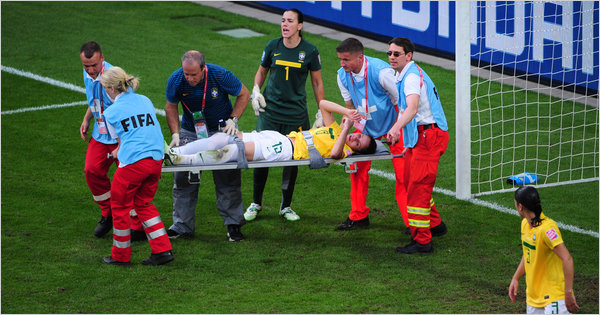
When women play football (or soccer in U.S.), the individual interruptions, for instance for substitutions or to cheer a goal, are a lot shorter than when men play. In particular after injuries men remain on the ground significantly longer. This is what sports scientists discovered after analyzing 56 football games and evaluating the place, time and duration of every single interruption of the game.Interruptions are frequent in football: Football players (m/f) spend on average 38 percent of the total game time not chasing the ball. This was established by sports scientists from the Chair of Training Science and Sports Informatics at TUM in a study of 56 football games. In some games, the interruptions took up as much as 53% of the time, thus exceeding the duration of the actual sports activity.
Johannes Eisele/Agence France-Presse — Getty Images

In sum, interruptions in men’s and women’s football are about the same. The individual interruptions, though, are significantly longer in men’s football. Cheering a goal, for instance, takes almost a full minute with men, while women only cheer half as long. At 45 seconds, substitutions in men’s football take almost 10 seconds longer than in women’s football. Particularly striking are the differences in the duration of injury interruptions — men remain on the ground 30 seconds longer. Overall, when women play, interruptions are more frequent, but the game generally resumes much faster than with men.

TUM sports scientist Prof. Martin Lames explains: “In general the differences can be interpreted as follows: For men the thought of staging themselves is much more pronounced than for women, where the game itself is obviously paramount.” Putting on a show, play-acting and protesting are more typical of men. Lames says, “The reason for this could be that men’s football generally pulls in more spectators and receives greater media coverage.”

Malte Siegle, doctoral candidate at the Chair, adds: “We can even provide evidence that men use interruptions tactically. As many fans have conjectured, when they are in the lead, players take their time with injuries. Much more so than if the score is even, or when the other side is leading. This behavior cannot be observed in women’s football.”

Prof. Martin Lames’s team of researchers at the Chair of Training Science and Sports Informatics is using the method of “Case-by-Case Analysis of Game Interruptions,” which they developed, to cast light on how football games are structured. The results will help the scientists determine how football players (m/f) might best prepare for a game. The comparison between women’s and men’s football was actually the byproduct of a research project.

The Women’s World Cup, which just started in Germany, will show whether or not these differences will persist in light of the fact that women’s football is enjoying increasing numbers of spectators and growing media attention.

In follow-up: also see: http://www.nytimes.com/2011/07/12/sports/soccer/at-the-womens-world-cup-drama-without-all-the-dramatics.html?emc=eta1

Reference: Technische Universitaet Muenchen (2011, June 29). Women get up sooner than men after a fall in soccer, study finds. ScienceDaily. Retrieved July 4, 2011, from http://www.sciencedaily.com/releases/2011/06/110629132548.htm

Tagged with: , ,
Posted in Football, Science General, Sport Science

Sport science and chances – what would you do if you knew the chances to win?

When you think about chances it is easy to think about gambling. But also in science chances are important. Scientists use statistics to discover which theories are more likely then others. But the notion of chance always remains relatively abstract. What is a chance? And more important; what would you do if you knew the chance? Sport scientist Gert-Jan Pepping studied how you might be able to increase the chances that a team wins in a soccer penalty shootout.

An old video now, with subtitles!

Enjoy and don’t forget to click on the cc-button to turn on the subtitles (English or Dutch) or read the transcript below.

What should you do if you knew the chance to win?

[Gert-Jan] If you knew the chance to win? Then you should cheer! And you should cheer in a way that is clearly visible.

You can influence chances. Sport and movement scientist Gert-Jan Pepping studied how players take penalties in association football and which factors influence which team wins the penalty shootout. His research will change the way in which penalties are taken forever.

[Gert-Jan] We have particularly looked at: how many of the players that show a particular type of celebrating end up in the winning team. Of those players that don’t show any emotion when they have scored, 50% ends up in the winning team and 50% ends up losing. Of those people that show a bit more when they have scored, about 60% ends up in the winning team and about 40% loses. And of those players that dare to show a lot of celebrating – and by the way, not many players dare to do this, of those players about 80% ends up winning and only 20% lost the shootout as a team.

[Gert-Jan] But of course you can also miss your penalty. Not every penalty is scored.What our research shows is that also in those situations it really helps when you visibly show that you are extremely disappointed that you have missed your penalty. Football players that are visibly ashamed of their miss have a bigger chance to win the shootout compared to those that don’t show any emotions.

[Gert-Jan] Look, this is what it is about [points at computer monitor] van Nistelrooi scores a very important goal, and he visibly shows that he is very happy with it, he celebrates, and shares it, right after the score with his goalkeeper [vd Sar]. And this is an important moment [points at computer monitor], when he shares his emotions of happiness and pride with his teammates. He infects them with positive emotions. The moment they see him cheer, yeah, then they can’t help but feel those same emotions. They all share the same goal of winning the shootout so they will catch the same emotions, and when it is their turn to take the next penalty then it will be beneficial if they experience positive emotions. The associated chemicals that are released in your brain and bloodstream will help you when you have to make important decisions. And, also important, the opponents … of course they are really annoyed, and that causes different chemicals to be released in their brains and bodies. This will narrow their attention, their bodies and muscles will tighten up and the chances that they will miss their penalty will increase.

Pepping’s research is not only important for athletes and in sports. We can also use this knowledge in daily life.

[Gert-Jan] This is true for all decisions that require a broad attention. Whether it’s a fireman that has to safe peoples lives or an anaesthesiologist in an operating theatre. In those circumstances that people want or need to be creative, it is useful that chemicals run through your body and brain that are associated with positive emotions. And the reverse is true too. When you are anxious or frightened and experiencing negative emotions then that will cause your attention to narrow and that will have a negative effect on your ability to make creative decisions.

G.J.Pepping – Center for Human Movement Sciences – University of Groningen

Tagged with: , , , , , , ,
Posted in Football, My own research, Science General, Sport Science

Performing Under Pressure in Elite Football

Watch Geir Jordet present a nice overview of research on performing under pressure in elite football. Geir shows how high ego, ego threat, and emotional distress can lead to self regulation failure, that is, missed penalties in footbal. He also gives examples of how effective emotion regulation, including celebrating, helps players perform under pressure.

Enjoy!

Tagged with: , , , , ,
Posted in Football, My own research, Sport Science

Player position data in football: On using it differently! A dynamical system’s perspective.

Get inspired to use player position data in a different way. Here’s Wouter Frencken presenting at the VIIth World Congress on Science & Football 2011 in Tokyo.

Enjoy!

Tagged with: , , , , ,
Posted in Dynamical Systems, Ecological Psychology, Football, Joint Action, Sport Science

When Football meets Philosophy

‘But the Germans are disputing it: Hegel is arguing that the reality is merely an a priori adjunct of non-naturalistic ethics; Kant via the categorical imperative is holding that ontologically it exists only in the imagination; and Marx is claiming it was offside.’ – isn’t this the funniest thing anybody has ever said in the English language?

Enjoy!

Tagged with: ,
Posted in Football, Science General

Dennis Bergkamp On The Greatest Goal He Ever Scored

Great players, great expression of emotions. Bergkamp is my favourite great player – this is what he said about him celebrating his greatest goal ever …
___
At that moment I thought about when I was seven or eight years old, playing football in the house, you know?  This is the moment!  It’s a good feeling.

___

Yeah.  What can you compare it to?  Different sports?  Like running the hundred metres and you know this is going to be a good time?  But you’re in that moment.  That’s the feeling. After the first two touches… that moment!  You give absolutely everything in that movement. It’s like your life has led up to this moment.
___

Read the whole post here.

And of course … the goal!

Tagged with: , , ,
Posted in Football